Event camping calculator
How many people can camp at your event?
Start with your field or guest list. Work out space for tents, campervans, caravans and parking. Free to use, with no sign-up.
1. Your camping area
Include camping and any parking in this area. Leave out stages, marquees and other event space.
1. Your overnight guests
Include children. Allow extra space for day visitors and staff parking.
2. How will people camp?
For example, enter 8 tents and 2 campervans. We use that mix for your estimate. Each tent or vehicle takes one pitch.
Pitch sizes and people
These sizes are examples. Each pitch must include space for ropes, awnings and the gaps between tents or vehicles.
3. Where will cars park?
Campervans need no extra car space. Caravan pitches include the towing car.
Paths, facilities and unusable ground
We add space for paths and facilities as well as parking. Choose an allowance below; your final layout may need more.
Updates as you change your answers.
How the space is used
| Camping type | Pitches | People |
|---|
Larger pitches need more land, including more space for paths and facilities.
Check your answers to see the estimate.
This is a space estimate, not a ticket limit. Check the layout, ground, access and facilities with your site team.
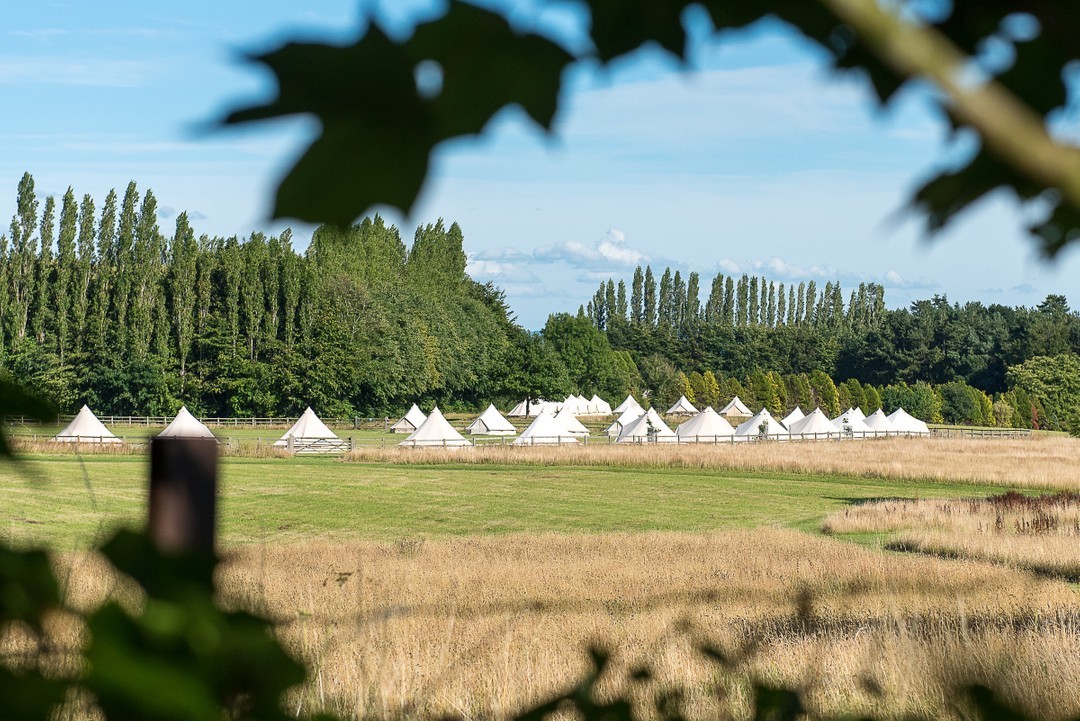 Want tents ready for your guests?
How many tents and people can camp on one acre?
Using the example below, one acre allows 44 tent pitches for 88 people, including parking. With parking elsewhere, it allows 67 pitches for 134 people.
This assumes 8 m × 6 m pitches, two people and one car per tent, 30 m² per car, and an extra 25% of the pitch area for paths and facilities. Your site may need more space.
| Area | Parking | Tent pitches | People |
|---|---|---|---|
| ½ acre | In the field | 22 | 44 |
| 1 acre | In the field | 44 | 88 |
| 1 acre | Elsewhere | 67 | 134 |
| 1 hectare | In the field | 111 | 222 |
These examples assume all the ground is usable. They are not approved site capacities. Parking elsewhere still needs land.
How much land do you need for 100 camping guests?
At two people per tent, 100 guests need 50 pitches. Using the sizes above, that is 2,400 m² for pitches, 600 m² for paths and facilities, and 1,500 m² for 50 cars: 4,500 m² in total, about 1.11 acres or 0.45 hectares.
With parking elsewhere, you need 3,000 m² for camping plus 1,500 m² for parking. Choose “I have guests” to try your own numbers.
How the camping calculator works
- Enter your field size or guest count. Leave out other event areas. Enter unusable ground separately.
- Choose your camping mix. Each tent, campervan or caravan uses one pitch. Set its size and how many people it sleeps.
- Add parking, paths and facilities. Car numbers follow your tent mix and car-sharing choice.
Pitch area is width × length × number of pitches. We add your chosen allowance for paths and facilities, then the space for cars, rounded up to whole cars.
We add whole pitches in your chosen mix until the next one would exceed your area, or until everyone has a sleeping place. This is a space calculation, not a map of your site.
Event camping questions
What size should a tent pitch be?
There is no single standard. Kennexstone offers 6 m × 5.5 m and 8 m × 6 m pitches. Silverburn has 6 m × 6 m and 6 m × 8 m pitches, with cars parked separately.
Our starting tent pitch is 8 m × 6 m (48 m²). Change it to allow for your tents, ropes, awnings and required spacing.
How is parking worked out?
We count one car per tent, including glamping, unless you choose car sharing. We round up to whole cars and multiply by the space per car. Campervans need no extra car space; caravan pitches include the towing car.
Allow separately for staff, day visitors, extra cars and accessible parking.
How does the camping mix work?
Eight tents and two campervans means roughly four tent pitches for each campervan pitch. We keep that balance as we add pitches. Small sites may differ slightly because we only count whole pitches.
How much space should I leave for paths and facilities?
We start with 25 m² for every 100 m² of pitches. You can try 15 or 40, or choose zero if already included in your pitch sizes.
These are example allowances. An area measurement cannot tell us where paths, toilets, water points or emergency access should go. Your site team needs to check those.
Can I sell this many camping tickets?
Not from this estimate alone. Confirm the layout, access and facilities with your site team before setting attendance. See HSE’s site design guidance.
Do I need to hire bell tents?
No. The calculator works with guests’ own tents and vehicles. Add glamping to your mix only if some guests want ready-pitched tents.
How many square metres are in an acre or hectare?
One acre is about 4,046.86 m². One hectare is 10,000 m², or about 2.47 acres. The calculator converts these for you.
Camping for festivals, weddings and private events
Use the calculator for overnight camping at festivals, weddings, retreats and parties. If some guests want tents set up for them, explore The Glamping Group’s bell tent hire.
Method and sources checked . Check pitch sizes and the final layout with your site team.